
The Art of Delegation: How to Let Go as a New Tech Lead
The transition from Senior Engineer to Tech Lead is often painful because the skills that got you promoted (writing fast, perfect code) are the exact skills that will make you fail as a lead.
As a Senior Engineer, your value is independent output. As a Lead, your value is the team's output. If you continue to hoard the hard problems because "it's faster if I do it," you become the bottleneck and your team stagnates.
In this guide, we explore how to shift your mindset from "Maker" to "Multiplier."
Here is what we'll cover:
- The Trap: Why we default to "I'll just do it myself."
- The Framework: How to decide what to delegate (The Eisenhower Matrix for Engineering).
- The Handoff: How to delegate context, not just tickets.
- The Levels: Adjusting autonomy based on trust.
1. The "Hero" Trap
We tend to avoid delegation for three reasonable-sounding but destructive reasons:
- Speed: "It will take me 1 hour to do it, but 3 hours to explain it."
- Quality: "If they mess it up, I'll just have to fix it anyway."
- Guilt: "I don't want to dump the boring work on them."
The reality is that "Speed" is a short-term metric. Spending 3 hours explaining it today means you never have to do it again. You are investing time, not spending it.
Mentor Tip: When you write code, you add linear value (+1 feature). When you unblock a team member, you add exponential value (they can now deliver +N features forever).
2. What Should You Delegate?
Not everything can be offloaded. I use a modified prioritization matrix to decide.
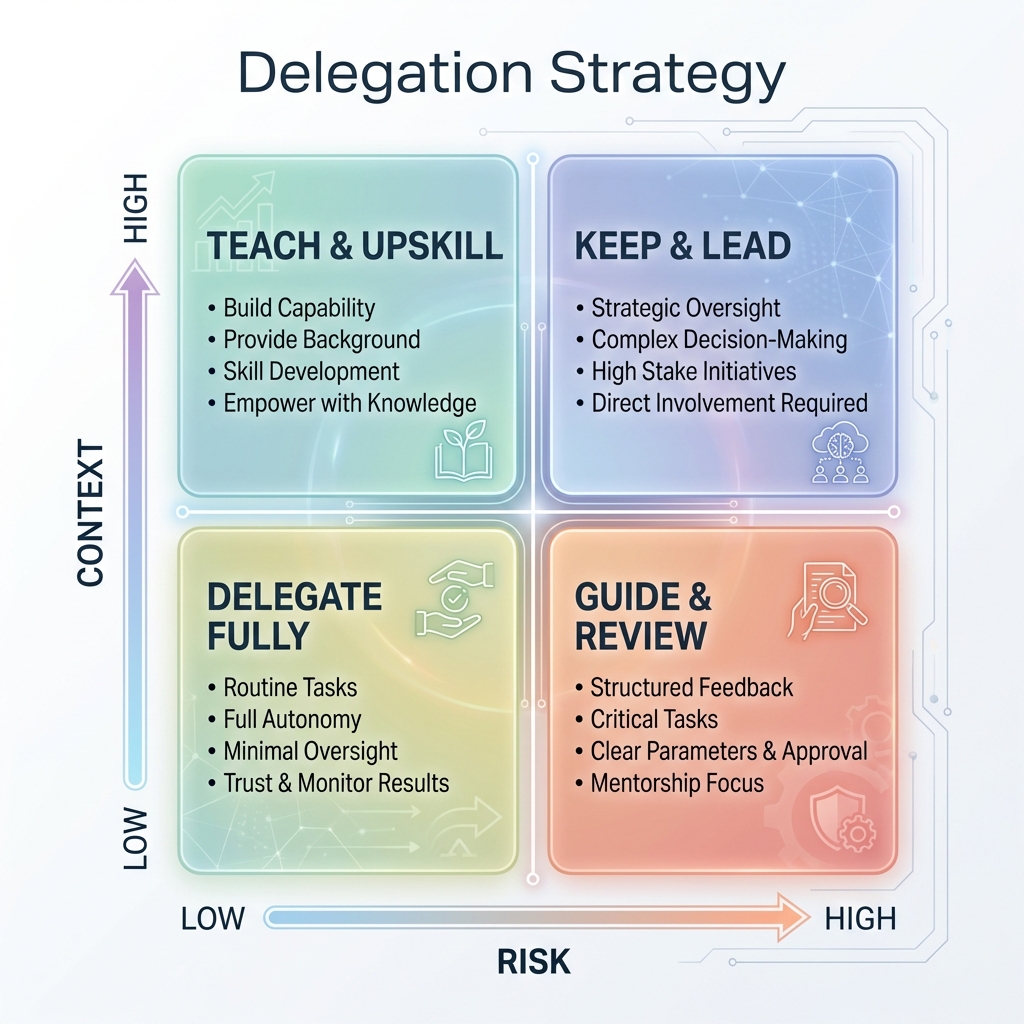
| Task Type | Example | Action |
|---|---|---|
| High Context / High Risk | Designing the core database schema. | Keep. This needs your experience. |
| Low Context / High Risk | Deploying to Production. | Delegate with Guardrails. Teach them, but review everything. |
| High Context / Low Risk | Writing internal documentation. | Delegate with Preview. Great for onboarding new hires. |
| Low Context / Low Risk | Fixing UI bugs, minor refactors. | Delegate Fully. Just let them run. |
3. How to Delegate (The "Context Object")
Bad delegation looks like throwing a Jira ticket over the wall. Good delegation involves passing the full "Context Object."
When you hand off a task, you must explicitly define:
- The Goal: What does "Done" look like?
- The Constraint: What are the hard limits (deadline, budget, performance)?
- The Why: How does this fit into the product strategy?
What to Say: "I'd like you to own the new Search API. The goal is sub-200ms latency. The constraint is that we cannot introduce new infrastructure costs. I'm handing this to you because you wanted to get better at performance optimization. I trust you to figure out the 'How'."
4. The Levels of Autonomy
You don't delegate to a Junior Engineer the same way you delegate to a Senior. Tailor your trust level.
- Level 1 (Direct): "Do exactly what I say." (Crisis mode only).
- Level 2 (Inquire): "Look into this and tell me what you plan to do before you start."
- Level 3 (Inform): "Decide and act, but let me know what you did."
- Level 4 (Detach): "Decide and act. I don't need to know."
The Mistake: Most leads default to Level 4 too early ("I trust you!"), the engineer falters, and then the lead snaps back to Level 1 ("Move over, I'll drive").
Case Study: The "Hero" Who Burned Out
I coached a Tech Lead named Alex. He was brilliant. He worked 60 hours a week fixing bugs because "it's faster if I do it."
The Symptom:
- Alex was exhausted.
- His Senior Engineers were bored (and starting to interview elsewhere).
- The team velocity was capped at "Alex's typing speed."
The Intervention: We forced Alex to delegate all "Level 2" tasks (Investigation).
- Old Alex: "I'll fix this bug." (1 hour).
- New Alex: "Here is the bug. Spend 30 mins investigating and tell me your plan." (15 mins discussion).
The Result: At first, it was slower. But after 3 weeks, the team could fix bugs without him. Alex dropped to 40 hours/week, and team throughput doubled because 4 people were fixing bugs instead of 1.
The Fix: Start at Level 2. Ask for their plan. If the plan is good, move to Level 3. Earned autonomy builds confidence.
Summary
Delegation is not about laziness; it is about leverage.
- Audit: Look at your calendar. What are you doing that a Senior Engineer could do?
- Invest: Spend the extra hours teaching it.
- Trust: Let them struggle a little. It's how they learn.
If you do your job right, eventually your team won't need you to write code at all. And that is the ultimate victory.


